

Soluble Corn Fiber Market Size to Worth USD 83.18 Billion by 2035, Driven by clean-label reformulation, functional beverages, and advanced ingredient optimization
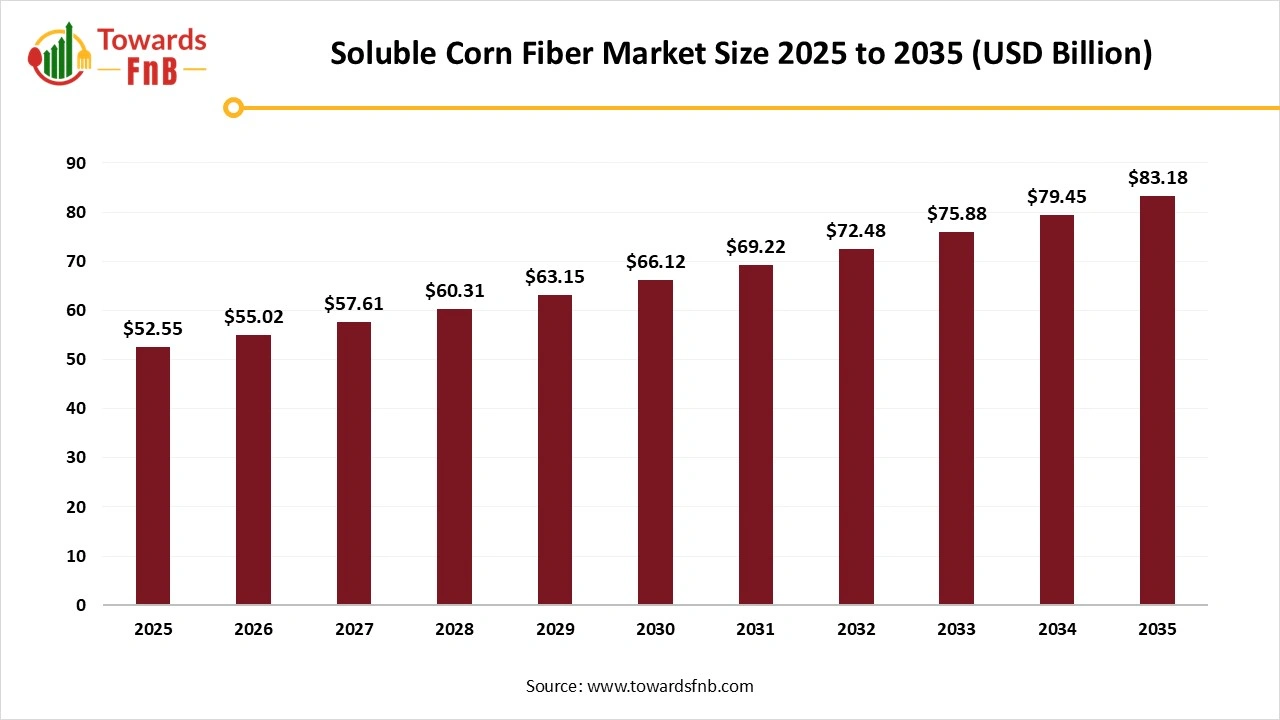
According to Towards FnB, the global soluble corn fiber market size is calculated at USD 52.02 billion in 2026 and is expected to reach USD 83.18 billion by 2035, expanding at a CAGR of 4.7% during the 2026 to 2035 forecast period. This steady growth trajectory reflects the ingredient’s increasing role in long-term food reformulation strategies rather than short-term demand cycles.
Ottawa, Jan. 29, 2026 (GLOBE NEWSWIRE) -- The global soluble corn fiber market size was valued at USD 52.55 billion in 2025 and is predicted to grow from USD 52.02 billion in 2026 to reach around USD 83.18 billion by 2035, as reported by Towards FnB, a sister firm of Precedence Research.
The market growth is observed due to the diversity in corn fiber applications and its higher usage in various industries. The market also observes growth due to higher demand for sustainability and growing awareness about it as well.
Note: This report is readily available for immediate delivery. We can review it with you in a meeting to ensure data reliability and quality for decision-making.
Access the Full Study Instantly | Download Sample Pages of the Report Now@ https://www.towardsfnb.com/download-sample/5993
Key Highlights of the Soluble Corn Fiber Market
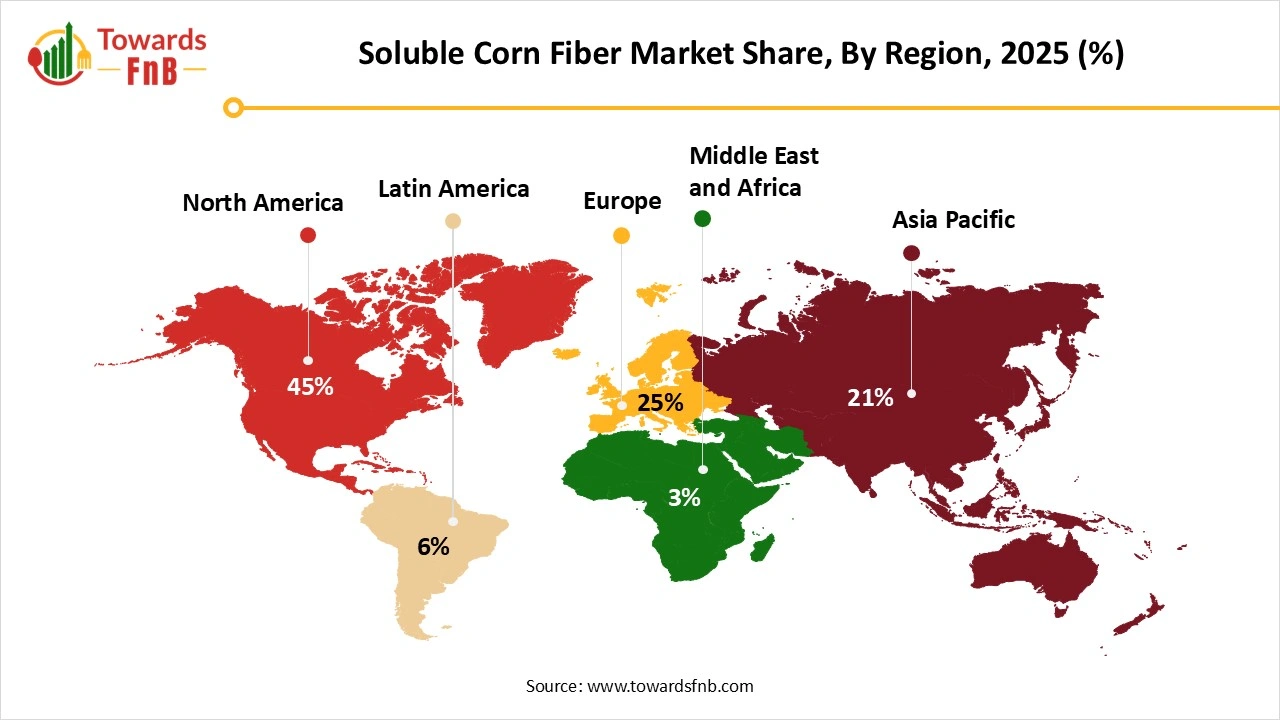
- By region, North America led the soluble corn fiber market with highest share of 45% in 2025.
- By region, the Asia Pacific is expected to grow in the foreseeable period.
- By type, the powder segment led the soluble corn fiber market in 2025.
- By type, the liquid segment is expected to grow in the foreseen period.
- By application, the dietary supplements segment led the soluble corn fiber market in 2025.
- By application, the food processing segment is expected to grow in the foreseeable period.
“Soluble corn fiber is rapidly transitioning from a niche functional ingredient to a core formulation component in sugar-reduced and prebiotic foods,” said Vidyesh Swar, Principal Consultant at Towards FnB. “Advances in AI-enabled processing are allowing manufacturers to achieve higher yields, tighter specifications, and better application performance, accelerating commercial adoption.”
Higher Demand for Healthier Choices Fueling the Growth of the Soluble Corn Fiber Industry
The soluble corn fiber market is observed to grow significantly due to healthier substitutes for sugar and higher demand for clean-label ingredients. Soluble corn fiber is a healthier replacement for refined sugar used in the preparation of various bakery and confectionery items, which is helpful for the growth of the market. It is also highly used in the preparation of various healthier food and beverages options, highly preferred by vegans, flexitarians, and vegetarians preferring a plant-based diet, further propelling the growth of the market. Technological advancements helpful in innovation and better absorption of the nutritional products further fuel the growth of the market.
Technological Advancements are helpful for the Growth of the Market
Technological advancements in the form of AI integration for process optimization, functional customization, and enhanced extraction help to fuel the growth of the market. The procedure also helps in the creation of novel products, further fueling the growth of the market. Technological advancements also help in enhancing the purity and product yield, further elevating the growth of the market. Rising innovations for better digestive health, increasing thermal stability, and improved sensory properties are other major factors helpful for the growth of the soluble corn fiber industry.
Impact of AI in the Soluble Corn Fiber Market
Artificial intelligence is increasingly being applied across the global soluble corn fiber market to improve process efficiency, functional consistency, and specification control for applications in beverages, bakery, dairy alternatives, confectionery, and nutrition products. Machine learning models analyze variability in corn feedstock composition, enzymatic hydrolysis behavior, and molecular weight distribution to optimize conversion pathways that deliver targeted solubility, sweetness modulation, and digestive tolerance. In product development, AI supports functionality prediction by modeling how soluble corn fiber performs under different pH, thermal, and shear conditions, enabling formulators to design fiber systems that maintain clarity, viscosity control, and stability across diverse processing environments.
During manufacturing, AI-driven process control tools monitor parameters such as enzyme dosing, reaction time, temperature, and filtration efficiency to reduce batch variability and improve yield consistency at industrial scale. AI is also applied in shelf-life and application stability modeling, where predictive analytics assess risks related to precipitation, viscosity drift, and interaction with sweeteners or acids during storage and global distribution. From a quality and regulatory perspective, AI assists in specification harmonization, compositional verification, and labeling alignment by mapping product attributes against international food safety and nutrition standards referenced by the Food and Agriculture Organization and the Codex Alimentarius Commission.
View Full Market Intelligence@ https://www.towardsfnb.com/insights/soluble-corn-fiber-market
Recent Developments in the Soluble Corn Fiber Market
- In November 2025, Tereos, a French cereal processor, launched Actifiber, a corn-based ingredient for fiber enrichment across food products. The new product is made from a non-GMO formulation with preserved color and flavor.
- In July 2025, PepsiCo announced that it would be launching its own prebiotic carbonated soft drink with Pepsi Prebiotic Cola, featuring three grams of prebiotic fiber per 12-ounce can. The product was introduced in the market in November 2025.
New Trends of the Soluble Corn Fiber Market
- Higher demand for fortified, functional, clean-label, and healthier options is one of the major factors for the growth of the market.
- Technological advancements to improve bioavailability are another major factor fueling the growth of the market.
- Use of corn fiber as a sustainable and biodegradable option also helps to propel the growth of the market.
Product Survey of the Soluble Corn Fiber Market
| Product Category | Description or Function | Common Forms or Variants | Key Applications or User Segments | Representative Brands or Product Types |
| Standard Soluble Corn Fiber | Low-digestible carbohydrate used for fiber enrichment with minimal impact on taste and texture | Syrup, powder | Bakery products, beverages, nutrition bars | Soluble corn fiber ingredients |
| Low-Viscosity Soluble Corn Fiber | Designed to provide fiber enrichment without significantly increasing thickness | Clear syrups, fine powders | Beverages, dairy alternatives, clear drinks | Low-viscosity soluble fiber systems |
| High-Fiber Soluble Corn Fiber | Formulated to deliver higher fiber content per serving | Concentrated powders | Nutrition bars, cereals, supplements | High-fiber corn fiber ingredients |
| Sugar-Reduction Soluble Corn Fiber | Used to partially replace sugar while maintaining bulk and mouthfeel | Syrups with sweetness-masking properties | Reduced-sugar foods and beverages | Sugar-replacement soluble fiber systems |
| Clean-Label Soluble Corn Fiber | Fiber ingredients positioned for label friendliness and neutral sensory profile | Non-GMO, minimally processed variants | Clean-label and premium food brands | Clean-label soluble corn fiber |
| Soluble Corn Fiber for Bakery | Optimized for moisture retention and texture in baked goods | Heat-stable powders | Industrial bakeries, snack producers | Bakery-grade soluble fiber |
| Soluble Corn Fiber for Beverages | Highly soluble fiber with clarity and stability in liquid systems | Beverage-grade syrups | Functional drinks, flavored waters | Beverage-stable soluble fiber |
| Soluble Corn Fiber for Nutrition Bars | Supports binding, softness, and fiber claims in bars | Syrup-based binding systems | Energy and nutrition bar manufacturers | Bar-application soluble fiber |
| Prebiotic Soluble Corn Fiber | Supports gut microbiota activity with low glycemic response | Prebiotic-labeled powders and syrups | Functional foods, digestive health products | Prebiotic soluble corn fiber |
| Specialty Soluble Corn Fiber | Application-specific fibers tailored for processing or sensory needs | Customized blends | Food manufacturers with specific formulation needs | Customized soluble fiber solutions |
For Detailed Pricing and Tailored Market Report Options, Click Here: https://www.towardsfnb.com/checkout/5993
Soluble Corn Fiber Market Dynamics
What Are the Growth Drivers of the Soluble Corn Fiber Market?
Higher demand for healthier and plant-based food and beverage options is one of the major factors for the growth of the market. The market also observes growth due to the growing population of health-conscious consumers such as vegans, flexitarians, and vegetarians. The market also observes growth due to higher demand for organic, functional, and fortified options by consumers with lifestyle-related health issues. Favorable government policies and a supportive regulatory framework also help to propel the growth of the market.
Supply Chain Issues Hampering the Growth of the Market
Issues obstructing a smooth supply chain are one of the major restrictions in the growth of the market. Issues such as high prices of raw materials, climatic conditions, geopolitical issues, and regulatory problems of a region are a set of major problems that hamper the growth of the market. Transportation problems obstructing the supply chain also hamper the growth of the soluble corn fiber market.
Higher Demand for Functional and fortified options will help fuel the Growth of the Market
The growing health-conscious crowd globally is one of the major factors fueling the demand for healthier, functional, and fortified food and beverage options. Hence, it is one of the major opportunities for the growth of the soluble corn fiber market. The market observes growth due to fueling demand for low-sugar, low-calorie, keto-friendly, and gluten-free options. Higher demand for processed, convenient, and ready-to-eat-and-drink food and beverage options also helps to fuel the growth of the market. Easy availability of such options on different platforms and in different forms also helps to fuel the growth of the market.
Feel Free to Get in Touch with Us for Orders or Any Questions at: sales@towardsfnb.com
Soluble Corn Fiber Market Regional Analysis
North America Dominated the Soluble Corn Fiber Market in 2025
North America led the soluble corn fiber market in 2025, due to higher demand for healthier alternatives by health-conscious consumers, which is helpful for the growth of the market. Hence, the region has a higher demand for gut-friendly, heart-friendly, digestive, low-calorie, and low-sugar healthier options, further elevating the market’s growth. Consumers following a specific diet are always in search of gluten-free, keto-friendly, and low-sugar options, further helpful for the market’s growth in the foreseen period.
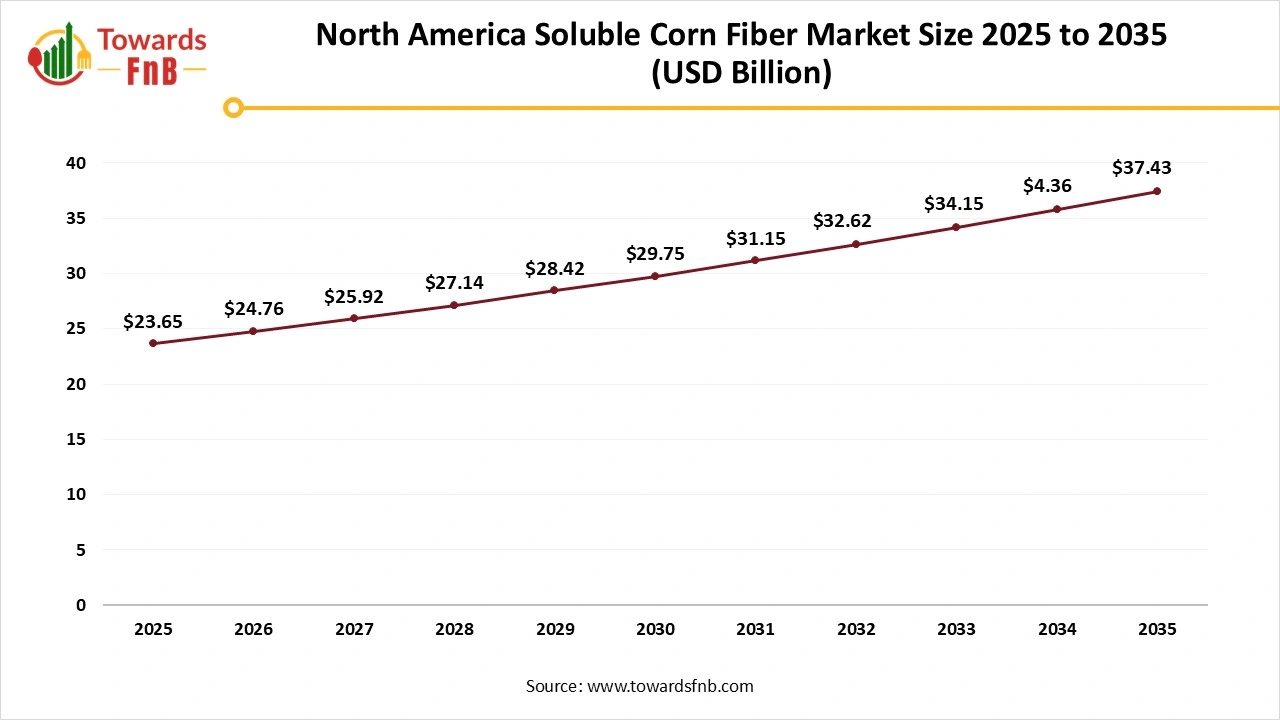
Technological innovations helpful to enhance the quality of the product are another major factor fueling the market’s growth in the region. The US has a major contribution to the growth of the market due to higher demand for healthier options that are low in sugar, low in calories, keto-friendly, high in fiber, protein-rich, functional, fortified, and plant-based, elevating the market’s growth.
Asia Pacific led the Soluble Corn Fiber Market in 2025
Asia Pacific is observed to be the fastest-growing region in the foreseen period due to changing consumer preferences, higher inclination towards health and wellness trends, and higher demand for plant-based and healthier options, fueling the growth of the market. Such factors lead to higher demand for low-fat, low-sugar, low-calorie, plant-based, gluten-free, and keto-friendly options, which are helpful for the growth of the market.
Higher demand for healthier options to manage lifestyle-related health issues, such as diabetes, obesity, and cardiovascular problems, in the region, with the help of functional and fortified choices, is another major factor helpful for the growth of the market. Rising disposable income, rapid urbanization, and technological advancements also help to fuel the growth of the market.
China has made a major contribution to the growth of the market due to the higher demand for healthier and plant-based options, along with technologically advanced features, which is another major factor fueling the growth of the market.
Europe is observed to have a Notable Growth in the Foreseen Period
Europe is observed to have a notable growth in the foreseen period due to higher demand for soluble corn fiber for the preparation of various foods and beverages that are low in sugar and low in calories, which is helpful for the growth of the market. Hence, such options are highly preferred by consumers following the health and wellness trends.
The soluble corn fiber is also highly used in the bakery and confectionery industry for low-sugar and low-calorie innovations, helpful for the market’s growth. Germany has made a major contribution to the growth of the market due to higher demand for healthier bakery and confectionery items with less sugar and fewer calories that are friendly for diabetics and for consumers managing weight.
Trade Analysis for the Soluble Corn Fiber Market
Top Exporters (Supply Hubs)
- United States: Major supplier of soluble corn fiber ingredients through large-scale production capacity focused on resistant dextrin products used in fiber-fortified foods.
- China: Significant exporter of soluble fibres and dietary fibre products derived from corn intermediates to global food processing markets.
- Poland: Noted exporter of soluble corn fibre ingredients into European food manufacturing supply chains.
- India: Emerging supplier of soluble corn fibre products given expanding ingredient processing capacity.
-
European Union producers (e.g., Netherlands, Belgium): Exporters of processed fibre ingredients and soluble corn fibre blends into regional and global markets.
Top Importers (Demand Centres)
- United States: Large importer of specialised soluble corn fibre products for use in nutrition, beverage, snack, and bakery applications.
- European Union: Major importer of soluble fibres reflecting high demand for fibre-fortified foods, functional nutrition, and clean-label ingredients.
- Japan: Importer of soluble corn fibre ingredients for processed foods, nutritional products, and functional beverages.
- South Korea: Growing importer linked to functional nutrition and expanding food ingredient markets.
-
Canada: Notable importer of soluble fibre ingredients supporting food and supplement manufacturers.
Typical Trade Flows and Logistics Patterns
- Bulk shipments of soluble corn fibre powders are shipped via containerized sea freight from major producing regions to global demand centres.
- High-purity ingredient consignments may be shipped by air freight when urgency or product quality dictates faster delivery.
- Regional distribution hubs repack, label, and manage compliance documentation prior to delivery to food processing companies and formulators.
- Seasonal production cycles of corn and processing inputs influence export timing and logistic planning, especially in major supplier countries.
Trade Drivers and Structural Factors
- Growing demand for dietary fibre in processed foods, beverages, and nutrition bars drives international trade in soluble corn fibre.
- Clean-label and functional food trends increase use of fibre ingredients that support digestive health claims.
- Plant-based and health-focused product innovation stimulates import demand in markets with high functional food penetration.
- Ingredient cost and quality differentials influence sourcing decisions across global producers.
- Regulatory recognition of fibre benefits in food labeling supports expanded use of soluble corn fibre in fortified food categories.
Regulatory, Quality, and Market-Access Considerations
- Soluble corn fiber must comply with national food safety and ingredient approval regulations, including fibre content, purity, and labeling requirements in importing markets.
- HS classification (e.g., 170290 vs 21069099) affects tariff treatment and documentation requirements during customs clearance.
- Allergen and nutritional labeling rules in key jurisdictions shape packaging and import compliance.
- In some markets, soluble corn fibre used in infant or specialised nutrition may face additional regulatory reviews.
Government Initiatives and Public-Policy Influences
- Public health nutrition policies promoting dietary fibre intake indirectly stimulate demand for imported soluble fibres.
- Agricultural and ingredient processing support programs in key exporting countries can expand production capacity for soluble corn fibre producers.
- Trade facilitation agreements and harmonised customs procedures influence tariff rates and procedural ease for ingredient imports.
Soluble Corn Fiber Market Report Scope
| Report Attribute | Key Statistics |
| Base Year | 2025 |
| Forecast Period | 2026 to 2035 |
| Growth Rate from 2026 to 2035 | CAGR of 4.7% |
| Market Size in 2026 | USD 52.02 Billion |
| Market Size in 2027 | USD 57.61 Billion |
| Market Size in 2030 | USD 66.12 Billion |
| Market Size by 2035 | USD 83.18 Billion |
| Dominated Region | North America |
| Fastest Growing Region | Asia Pacific |
| Regions Covered | North America, Europe, Asia-Pacific, Latin America and Middle East & Africa |
Have Questions? Let’s Talk—Schedule a Meeting with Our Insights Team: https://www.towardsfnb.com/schedule-meeting
Soluble Corn Fiber Market Segmental Analysis
Form Analysis
The powder segment led the soluble corn fiber market in 2025, due to the convenience provided by the form, further fueling the growth of the market. Powder form is easy to manage, has a longer shelf life, is easy to transport, and is easy to store, further fueling the growth of the market. Powder form is easy to blend in wet mixes and other formats of food and beverage options, further fueling the growth of the market. Higher demand for the form due to easy fortification without any compromise in mouthfeel and taste is another major factor fueling the growth of the market. Hence, it is highly demanded in the pharmaceuticals and nutraceuticals industry, ready-to-eat options, and processed and convenient options, fueling the growth of the market.
The liquid segment is expected to be the fastest-growing segment in the foreseen period due to higher demand for options such as ready-to-drink options, dairy, beverages, smoothie, and health-focused drinks, which will help to fuel the growth of the soluble corn fiber market in the foreseen period. Convenient and biodegradable packaging allows consumers to carry such beverages on the go and avoid junk, which is easily available outdoors, further fueling the growth of the market. Higher demand for plant-based and functional beverages is another major factor fueling the growth of the market.
Application Analysis
The dietary supplements segment dominated the soluble corn fiber market in 2025, due to the growing population of health-conscious consumers, which helped fuel the growth of the market. Hence, such consumers have a higher demand for healthier, plant-based, organic, functional, and fortified options to maintain the nutritional profile, further fueling the growth of the market. The market also observes growth due to higher demand for options that are friendly for the gut and immunity and that are also keto-friendly. Options that help to manage blood sugar levels, along with managing weight as well, are another major factor helpful for the growth of the market.
The food processing segment is expected to grow in the foreseeable period due to higher demand for healthier options by health-conscious consumers globally. Higher demand for plant-based options, low-calorie options, clean-label ingredients, and functional and fortified options further helps to fuel the market’s growth. Edible options helpful to manage weight, manage lifestyle-related issues, and manage chronic health problems are another major factor fueling the growth of the market. Hence, such factors altogether help to propel the growth of the market in the foreseen period.
Feel Free to Get in Touch with Us for Orders or Any Questions at: sales@towardsfnb.com
Additional Topics Worth Exploring:
- Tea Market: The global tea market size is projected to expand from USD 30.25 billion in 2025 to USD 54.68 billion by 2034, growing at a CAGR of 6.8% during the forecast period from 2025 to 2034.
- Gluten Free Food Market: The global gluten free food market size is increasing from USD 15.71 billion in 2026 and is expected to surpass USD 37.04 billion by 2035, with a projected CAGR of 10% during the forecast period from 2026 to 2035.
- Organic Food Market: The global organic food market size is expected to grow from USD 253.96 billion in 2025 to USD 660.25 billion by 2034, with a compound annual growth rate (CAGR) of 11.20% during the forecast period from 2025 to 2034.
- Canned Food Market: The global canned food market size is projected to expand from USD 144.43 billion in 2026 to reach around USD 218.37 billion by 2035, growing at a CAGR of 4.7% during the forecast period from 2026 to 2035.
- Canned Wines Market: The global canned wines market size is expected to increase from USD 142.20 million in 2026 to reach around USD 369.70 million by 2035, growing at a CAGR of 11.2% throughout the forecast period from 2026 to 2035.
- Plant-based Protein Market: The global plant-based protein market size is forecasted to expand from USD 22.10 billion in 2026 and is expected to reach USD 46.82 billion by 2035, growing at a CAGR of 8.7% during the forecast period from 2026 to 2035.
- Frozen Food Market: The global frozen food market size is expected to grow from USD 473.40 billion in 2026 to reach around USD 721.91 billion by 2035, at a CAGR of 4.8% over the forecast period from 2025 to 2034.
- Beverage Packaging Market: The global beverage packaging market size is projected to reach USD 285.66 billion by 2035, growing from USD 182.57 billion in 2026, at a CAGR of 5.1% during the forecast period from 2026 to 2035.
- Vegan Food Market: The global vegan food market size is evaluated at USD 24.77 billion in 2026 and is expected to reach USD 61.85 billion by 2034, with a CAGR of 10.7% during the forecast period from 2025 to 2034.
- Food Additives Market: The global food additives market size is rising from USD 128.14 billion in 2025 to USD 214.66 billion by 2034. This projected expansion reflects a CAGR of 5.9% throughout the forecast period from 2025 to 2034.
-
Coconut Products Market: The global coconut products market size is expected to climb from USD 14.18 billion in 2025 to approximately USD 33.71 billion by 2034, growing at a CAGR of 10.1% during the forecast from 2025 to 2034.
Strategic Overview of Major Players in the Global Soluble Corn Fiber Market
- Roquette Frères: Roquette leverages strong R&D and global scale to position soluble corn fiber as a premium, clean-label solution for sugar reduction and fiber fortification. Its application-driven innovation supports rapid adoption across bakery, beverages, and nutrition.
- Baolingbao Biology Co. Ltd: Baolingbao strengthens Asia’s soluble corn fiber supply through cost-efficient production and localized formulation support. The company plays a key role in accelerating fiber adoption in price-sensitive and high-growth regional markets.
- Cargill: Cargill’s integrated agri-supply chain and global customer reach make it a major volume driver in the soluble corn fiber market. Its ability to bundle fiber with broader ingredient systems supports large-scale reformulation initiatives.
- Jianlong Biotechnology Co., Ltd: Jianlong Biotechnology contributes to market growth by converting regional corn-processing capacity into scalable soluble fiber solutions. Its focus on efficiency and local demand supports wider penetration across Asian food and beverage manufacturers.
- Tate & Lyle PLC: Tate & Lyle positions soluble corn fiber as a reliable sugar-reduction and functional ingredient through strong application science and regulatory expertise. The company emphasizes co-innovation with global CPG brands to simplify reformulation.
- Ingredion Incorporated: Ingredion drives adoption by translating soluble corn fiber into processing-friendly formats and turnkey formulation systems. Its technical services and global footprint reduce development timelines for fiber-enriched product launches.
-
Archer Daniels Midland Company (ADM): ADM leverages end-to-end grain sourcing, processing, and logistics to ensure stable supply and pricing for soluble corn fiber. Its scale enables large-volume contracts and supports widespread use in beverages and snack applications.
Segments Covered in the Reports
By Form
- Powder
- Liquid
By Application
- Dairy Products
- Food Processing
- Dietary Supplements
- Animal nutrition
By Region
North America
- U.S.
- Canada
Asia Pacific
- China
- Japan
- India
- South Korea
- Thailand
Europe
- Germany
- UK
- France
- Italy
- Spain
- Sweden
- Denmark
- Norway
Latin America
- Brazil
- Mexico
- Argentina
Middle East and Africa (MEA)
- South Africa
- UAE
- Saudi Arabia
- Kuwait
Thank you for exploring our insights. For more targeted information, customized chapter-wise sections and region-specific editions such as North America, Europe, or Asia Pacific—are also available upon request.
For Detailed Pricing and Tailored Market Report Options, Click Here: https://www.towardsfnb.com/checkout/5993
Feel Free to Get in Touch with Us for Orders or Any Questions at: sales@towardsfnb.com
Unlock expert insights, custom research, and premium support with the Towards FnB Annual Membership. For USD 495/month (billed annually), get full access to exclusive F&B market data and personalized guidance. It’s your strategic edge in the food and beverage industry: https://www.towardsfnb.com/get-an-annual-membership
About Us
Towards FnB is a global consulting firm specializing in the food and beverage industry, providing innovative solutions and expert guidance to elevate businesses. With an in-depth understanding of the dynamic F&B sector, we deliver customized market analysis and strategic insights. Our team of seasoned professionals is committed to empowering clients with the knowledge needed to make informed decisions, ensuring they stay ahead of market trends. Partner with us as we redefine success in the rapidly evolving food and beverage landscape, and together, we’ll navigate this transformative journey.
Web: https://www.towardsfnb.com/
Our Trusted Data Partners
Precedence Research | Statifacts | Towards Packaging | Towards Chemical and Materials| Nova One Advisor | Food Beverage Strategies | FnB Market Pulse | Nutraceuticals Func Foods | Onco Quant | Sustainability Quant | Specialty Chemicals Analytics
For Latest Update Follow Us:
Discover More Market Trends and Insights from Towards FnB:
➡️Beverage Flavors Market: https://www.towardsfnb.com/insights/beverage-flavors-market
➡️Salt Market: https://www.towardsfnb.com/insights/salt-market
➡️Probiotic Food Market: https://www.towardsfnb.com/insights/probiotic-food-market
➡️Protein Bar Market: https://www.towardsfnb.com/insights/protein-bar-market
➡️Gluten-Free Bakery Market: https://www.towardsfnb.com/insights/gluten-free-bakery-market
➡️Europe Nutraceuticals Market: https://www.towardsfnb.com/insights/europe-nutraceuticals-market
➡️Non-Alcoholic Beverages Market: https://www.towardsfnb.com/insights/non-alcoholic-beverages-market
➡️Dry Fruit Market: https://www.towardsfnb.com/insights/dry-fruit-market
➡️Frozen Meat Market: https://www.towardsfnb.com/insights/frozen-meat-market
➡️Fish Oil Market: https://www.towardsfnb.com/insights/fish-oil-market
➡️Soft Drink Concentrates Market: https://www.towardsfnb.com/insights/soft-drink-concentrates-market
➡️Meal Kits Market: https://www.towardsfnb.com/insights/meal-kits-market
➡️Ethnic Food Market: https://www.towardsfnb.com/insights/ethnic-food-market


Legal Disclaimer:
EIN Presswire provides this news content "as is" without warranty of any kind. We do not accept any responsibility or liability for the accuracy, content, images, videos, licenses, completeness, legality, or reliability of the information contained in this article. If you have any complaints or copyright issues related to this article, kindly contact the author above.
