
World Water Day: Sinergia Animal Highlights How the Global Food System Is Intensifying Pressure on Water Resources
World Water Day: Food Systems Driving Pressure on Global Water Resources
The water used behind the food on our plates
On World Water Day, attention turns to how food systems, such as meat production, strain global water resources, highlighting the need for sustainable choices.
BANGKOK, THAILAND, March 18, 2026 /EINPresswire.com/ -- Daily food choices have far-reaching effects on global water resources. On World Water Day, growing attention is being placed on how global food systems drive water consumption and are placing increasing pressure on freshwater resources.
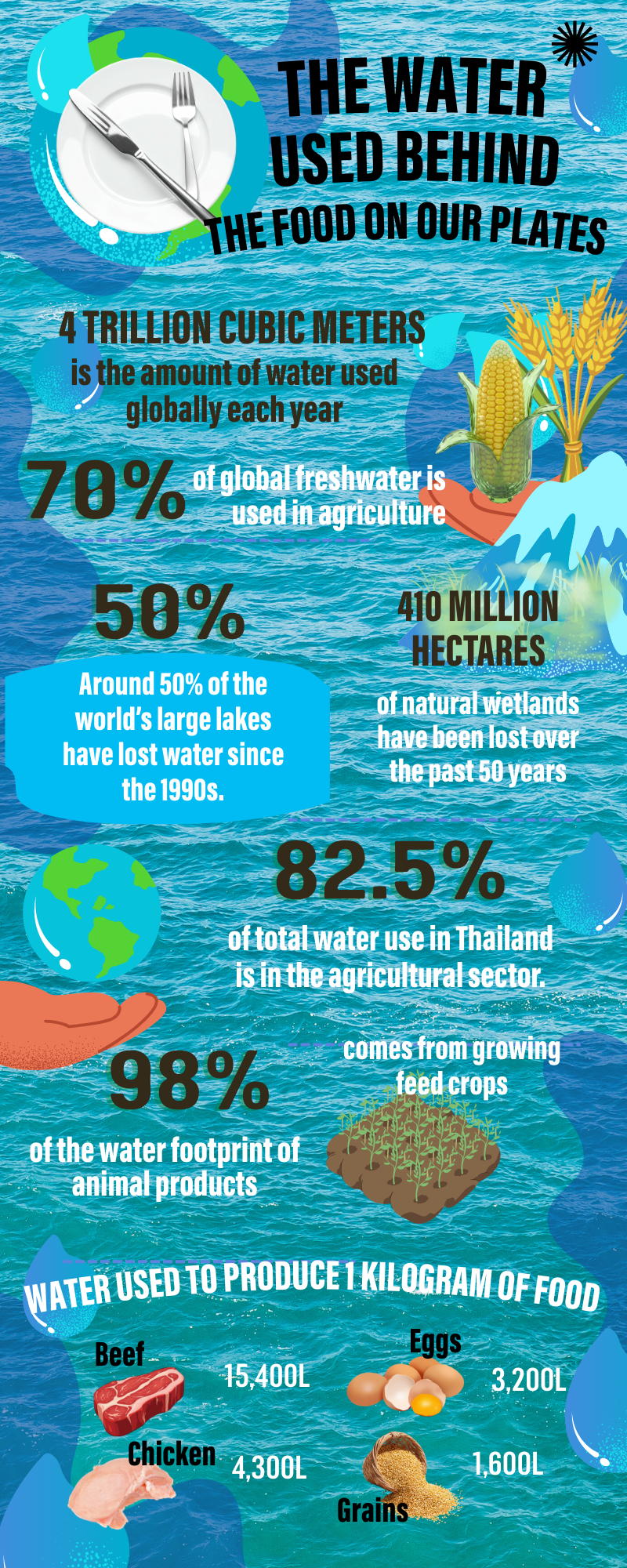
Water is the most extracted natural resource on Earth, with global usage estimated at around 4 trillion cubic meters per year. Yet water systems are under strain. In January, the United Nations warned that the world is entering a state of “global water bankruptcy,” where freshwater is being consumed faster than it can be replenished.
This warning comes amid alarming trends: around 50% of the world’s large lakes have shrunk since the early 1990s, half of global domestic water use relies on groundwater, and 410 million hectares of wetlands, nearly the size of the European Union, have disappeared over the past five decades.
The challenge is particularly urgent in the Asia-Pacific region, where nearly two billion people lack access to safe water and sanitation, and an estimated 80% of wastewater is discharged untreated into the environment.
In Thailand, these pressures are increasingly visible. Groundwater remains a major source of drinking water, while pollution from urban sewage, industrial discharge, pesticides, fertilizers, and pharmaceutical residues, especially in rivers such as the lower Chao Phraya, continues to raise concerns. National estimates indicate that around 9.7 million cubic meters of domestic wastewater are generated daily, yet treatment capacity covers only a fraction of this volume.
The Hidden Water Cost of Food
Agriculture is one of the largest drivers of global water use, accounting for around 70% of freshwater withdrawals, a figure projected to rise by 15% by 2050.
Within the food system, animal agriculture is particularly water-intensive, requiring water not only for animals’ drinking needs but also for growing feed, cleaning facilities, and processing products. Research shows that around 98% of the water footprint of animal products comes from feed production.
In Thailand, agriculture dominates water use, accounting for approximately 82.5% of total national demand, around 100 billion cubic meters in 2021.
As a result, animal-based foods typically have significantly higher water footprints than plant-based alternatives. Producing one kilogram of beef can require up to 15,400 liters of water, compared to around 1,600 liters for cereals. Egg and poultry production are also water-intensive, requiring approximately 3,200 liters and 4,300 liters per kilogram, respectively.
As freshwater scarcity intensifies, diets centered on water-intensive foods such as meat and dairy may place additional pressure on already stressed water systems.
Environmental Impacts
Beyond water consumption, industrial livestock production contributes to environmental degradation. Large-scale farms generate vast quantities of manure and wastewater, which can enter nearby water systems and trigger eutrophication, where excess nutrients fuel algae growth, deplete oxygen, and harm aquatic life.
The use of antibiotics in animal farming is another growing concern. Widely used to treat disease and prevent infections in intensive systems, these drugs can enter the environment through manure and wastewater, contributing to the spread of antimicrobial resistance.
Research in Thailand highlights these risks. Studies have identified multidrug-resistant bacteria, including resistant E. coli, in livestock environments, as well as antimicrobial-resistant bacteria in aquaculture systems. A broader meta-analysis across Southeast Asia also found antimicrobial resistance circulating across human, animal, and environmental systems.
Water pollution from agricultural runoff can therefore have serious consequences for ecosystems and public health, particularly in regions where rivers and coastal systems support livelihoods, fisheries, and agriculture.
Rethinking Food Systems
“Water scarcity is not only an environmental issue, but also a food system issue,” said Saneekan Rosamontri, Managing Director of Sinergia Animal in Thailand. “The way food is produced today has a direct impact on water resources, ecosystems, and the welfare of billions of farmed animals,” she added.
Industrial farming systems designed for high output often prioritize efficiency over animal welfare, confining animals in crowded environments where natural behaviors cannot be expressed. These conditions can lead to stress, injuries, and long-term health problems, while also intensifying environmental pressures such as pollution and disease risks.
Organizations such as Sinergia Animal, an international animal protection organization operating across the Global South, are helping drive this transition by supporting cage-free egg supply chains and promoting more sustainable food choices.
In 2025, the organization monitored 36 food and hospitality companies across six countries that had committed to cage-free egg policies but had not reported sufficient progress. Following engagement efforts, 12 companies, including Cargill, IKEA, and Colombina, improved transparency and strengthened their commitments.
The organization has also launched Thailand’s first supermarket ranking for cage-free policies, along with an annual Cage-Free Tracker, aimed at increasing transparency in food supply chains and raising public awareness.
On World Water Day, the global water crisis reminds us that the story of water does not begin with everyday use, it also begins on our plates. From feed production to environmental impacts, our food choices shape the future of freshwater resources, ecosystems, and communities worldwide.
Valaiporn Chalermlapvoraboon
Sinergia Animal
+66989298001 ext.
email us here
Visit us on social media:
Instagram
Legal Disclaimer:
EIN Presswire provides this news content "as is" without warranty of any kind. We do not accept any responsibility or liability for the accuracy, content, images, videos, licenses, completeness, legality, or reliability of the information contained in this article. If you have any complaints or copyright issues related to this article, kindly contact the author above.
